What Is The Temple With 1000 Faces In Kyoto?
The temple with 1000 faces in Kyoto is Sanjusangen-do, formally Rengeo-in, whose hall holds 1,001 Kannon statues. Here are its fees, hours and the legend behind the faces.
What Is The Temple With 1000 Faces In Kyoto?
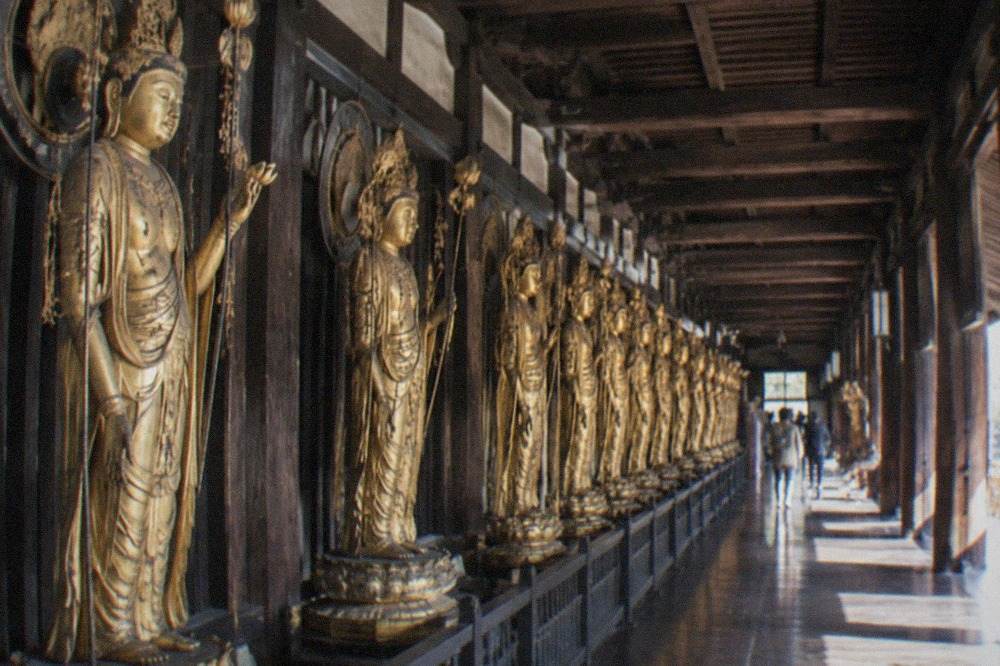
The temple with 1000 faces in Kyoto is Sanjusangen-do, formally named Rengeo-in, a Tendai-sect hall in the Higashiyama east of the city. The temple's own site states that 1,001 Kannon statues stand in the hall, an image it calls a forest of statues, and that the hall was founded inside Emperor Go-Shirakawa's detached palace. Every one of those gilded figures carries a different face, which is where the "1000 faces" search phrase comes from. This page sets out what is verified on the temple's own pages, what is legend, and how to plan a visit around one of the most concentrated sights in the city.
Why Is Sanjusangen-do Called The Temple Of 1000 Faces?
The nickname comes from the statues themselves: 1,001 gilded Kannon figures stand shoulder to shoulder in one hall, and each is carved with its own distinct face rather than a repeated mould. The temple's own site counts them as 1,001, a number it prints directly, while the "1000 faces" phrasing is a popular shorthand travellers use to describe the effect of the rows. The formal name, Rengeo-in, means the hall of the lotus king Kannon.
The visual effect is the point. The statues are arranged in ranks behind the central seated figure, and the hall is deliberately long, so the rows appear to multiply as your eye follows them into the dark. The name Sanjusangen-do itself is a measurement, not a devotional title: it means the hall of thirty-three bays, the space between the pillars, and the number carries Buddhist significance in its own right.
The hall's origin story explains the imperial scale. The temple's own history section states it was founded inside Emperor Go-Shirakawa's detached palace in the twelfth century, which is why a single room could be built to hold a statue army of this size. Go-Shirakawa was one of the most powerful retired emperors of the Heian period, and the complex that grew around his retreat became one of Kyoto's great temple precincts.
Visitors comparing Kyoto's headline temples often weigh this hall against the Golden Pavilion or the Kiyomizu stage. The difference is that Sanjusangen-do delivers its impact indoors, in a single unbroken view, which makes it a strong pick on a rainy day when the garden temples lose their appeal. For a wider sweep of the city's religious architecture, our guide to Kyoto's temples covers the full canon.
How Many Statues Are Really Inside Sanjusangen-do?
The temple's own site gives the count as 1,001 Kannon statues standing in the hall, and that figure is the one to trust. The central statue is a seated Kannon, flanked by ranks of standing figures in rows of ten across the depth of the hall. What the temple does not publish is a breakdown of how many are Heian-period originals and how many are Kamakura-era replacements, so any guide that prints that split is guessing.
The round number matters less than the arithmetic behind it. The seated principal image is counted as one, and the standing figures bring the total to 1,001, a number chosen for religious reasons rather than as an inventory. The temple calls the assembly a forest of statues, and the phrase is apt: the figures are packed tightly enough that the hall reads as a single golden mass.
A note on what else you may have read. Some sources describe a tradition that somewhere among the 1,001 faces is one that resembles your own, and that searching for it is part of the visit. That idea is a widely repeated tradition the temple does not assert on its own site, so treat it as folklore rather than doctrine. It is a good story, and it may well be true, but the temple's pages do not claim it.
Photography rules are another gap. The temple's site as read by our research does not publish a photography policy, so do not arrive assuming either permission or a ban. The practical default at Japanese statue halls is no photographs indoors, and the surprise of the room survives without a camera. For more on the city's headline sights, see what Kyoto is known for.
What Does It Cost And When Is Sanjusangen-do Open In Kyoto?
General admission is 600 yen, with junior high and high school students at 400 yen and elementary school children at 300 yen, and groups of 30 or more pay 550, 350 and 250 yen respectively. The hall is open every day of the year: 8:30 to 17:00 from 1 April to 15 November, and 9:00 to 16:00 from 16 November to 31 March, with reception ending 30 minutes before closing in both seasons.
The two-tier timetable follows the light. The hall is unheated and relies on daylight through the doors, so the winter season shortens both the opening hour and the closing hour. Arriving early in either season is the reliable crowd strategy, because the hall sits on the museum corridor of eastern Kyoto and tour groups tend to land between mid-morning and early afternoon. The rest of the planning pages sit on Kyoto Travel Guide.
| Visitor category | Individual | Group (30+) |
|---|---|---|
| General adult | 600 yen | 550 yen |
| Junior high and high school | 400 yen | 350 yen |
| Elementary school | 300 yen | 250 yen |
For comparison against the other ticketed temples nearby, this is how the verified admissions line up:
| Temple | Adult admission | Notes |
|---|---|---|
| Sanjusangen-do | 600 yen | Open every day |
| Kiyomizu-dera | 500 yen | Single source, the temple does not print it |
| Kinkaku-ji | 500 yen | 9:00-17:00 year-round |
| Nanzen-ji Hojo garden | 600 yen | Sanmon gate ticketed separately |
| Kodai-ji | 800 yen | 1,200 yen combined with Entoku-in |
Getting there is simple. The hall is a short walk from Keihan Shichijo Station and roughly 15 minutes on foot from Kyoto Station's eastern side, which makes it one of the easiest headline temples to reach without a bus. If you are building a first-day plan around the station, the one day in Kyoto itinerary slots this hall in cleanly between the station area and the Higashiyama slope.
Is The "Find Your Own Face" Legend True?
No, and the honest framing matters: the temple's own site does not assert that any visitor can find their own face among the 1,001 statues. The idea that one of the Kannon figures bears the face of whoever is looking is a widely repeated tradition the temple does not assert. Treat it the way the shrine at Fushimi Inari treats its own founding story, as tradition rather than verified fact.
The comparison is not random. The head shrine of the Inari shrines, which counts about 30,000 affiliated shrines nationwide by its own account, hedges its founding date with the words "is said to have". Kyoto's old institutions are consistently careful about the line between recorded history and legend, and a visitor who respects that line gets more out of the city.
What is verifiable is the craft. Carving 1,001 distinct faces was a feat of organisation as much as artistry, with multiple workshops working to a shared canon so the figures would read as one assembly. That is why the hall rewards a slow second pass: the first look registers the mass, and the second starts picking out individual expressions, halo details and the small attendants arranged in front of the main ranks.
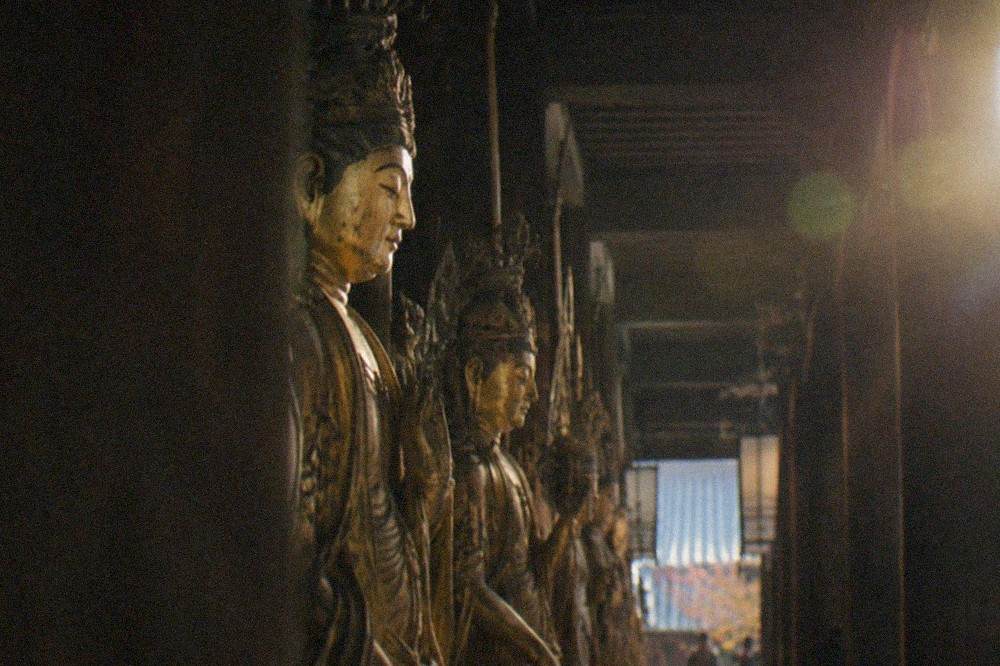
The hall also has a martial afterlife worth knowing. For centuries its veranda was the venue for Japan's most famous archery contest, the Toshiya, in which archers shot arrows down the full length of the building, and the temple preserves the records of the feats performed there. The hall you stand in is both a statue repository and one of Japan's oldest continuous sports venues.
What Else Is Near Sanjusangen-do In Kyoto?
The hall sits in eastern Kyoto within walking distance of the Kyoto National Museum, directly opposite it, and a 15 to 20 minute walk from Kiyomizu-dera's eastern slope and the Higashiyama lanes below it. The Shichijo and Gojo corridors along the Kamo River hold the nearest concentration of food and the nearest rail stations, and the Chion-in and Yasaka Shrine complex lies north along the river path.
The practical pairing is the museum. The Kyoto National Museum faces the hall across the street, and its Japanese gallery holds Buddhist sculpture that contextualises what you have just seen, including work from the same periods as the hall's statues. Doing the hall first and the museum second is the order most guides suggest, because the hall is the more crowded of the two and rewards the early start.
North along the river, the terrain changes. The Gion district and the slopes up to Kiyomizu-dera form the classic eastern walk, and the Higashiyama area guide covers the lanes between them. If your legs are willing, one long morning can run the temple, the museum, the river path and the Gion streets without a single bus ride.
For travellers who want a guided version of that eastern side, a small-group walking tour with an English-speaking guide covers the same ground with the stories attached. The Fushimi Inari Hidden Hiking Tour takes a different angle again, up the mountain behind the shrine rather than along the flat, and pairs well with a temple morning on a multi-day stay.
Common Questions About The Temple With 1000 Faces In Kyoto
What Is The Temple With 1000 Faces In Kyoto?
It is Sanjusangen-do, formally Rengeo-in, in eastern Kyoto. The temple's own site states that 1,001 Kannon statues stand in the hall, each carved with a different face, which is where the popular "1000 faces" phrasing comes from.
How much does Sanjusangen-do cost?
General admission is 600 yen, junior high and high school students 400 yen, and elementary school children 300 yen. Groups of 30 or more pay 550, 350 and 250 yen respectively.
Can you take photos inside Sanjusangen-do?
The temple's site does not publish a photography policy, so assume the standard Japanese statue-hall default of no indoor photography and plan to experience the hall without a camera.
Is the legend about finding your own face true?
The idea that one of the 1,001 statues bears your own face is a widely repeated tradition the temple does not assert. Enjoy it as folklore, but do not treat it as temple doctrine.
How long does a visit take?
Most visitors spend 30 to 45 minutes in the hall itself. Allow more if you plan to pair it with the Kyoto National Museum across the street, which faces the temple directly.
The hall earns its nickname honestly. One room, 1,001 faces, and a founding story that runs back to a retired emperor's palace, all for a 600 yen ticket a short walk from Kyoto Station, is about as concentrated as Kyoto gets.