What Is The 1000 Year Old Shop In Kyoto?
The 1000 year old shop in Kyoto is Ichimonjiya Wasuke, the aburamochi sweet shop beside Kiyomizu-dera. What it sells, how to visit it, and what else is nearby.
What Is The 1000 Year Old Shop In Kyoto?
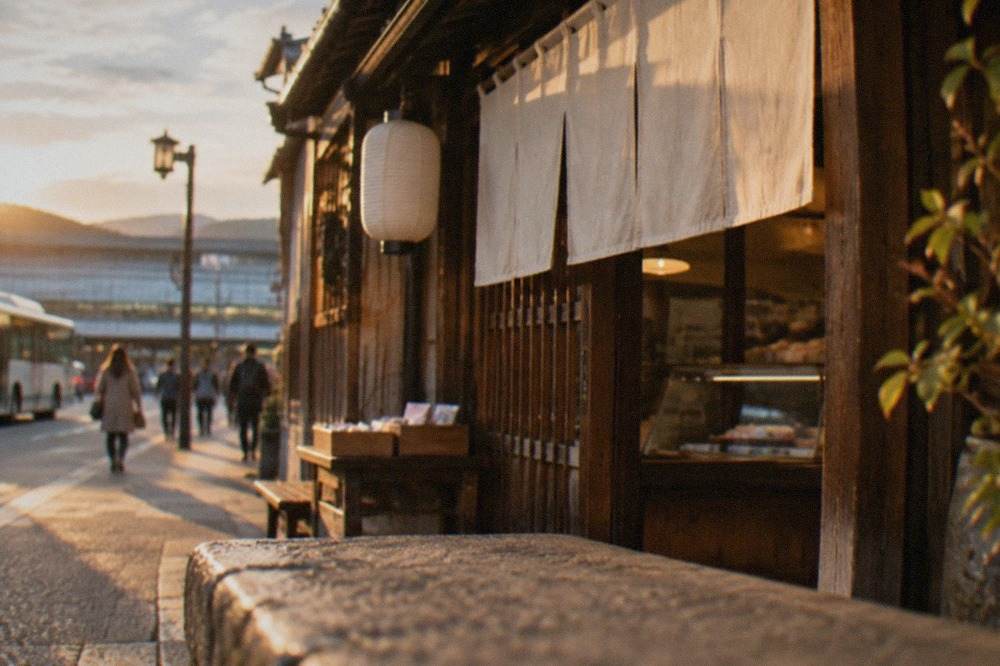
The shop the question almost always points to is Ichimonjiya Wasuke, a small sweet shop standing on the slope below Kiyomizu-dera in eastern Kyoto. It sells one thing, aburamochi, skewered rice cakes grilled over charcoal and rolled in sweet soybean flour, and it has sold that one thing continuously since the Heian period, which is the claim that earns it the "1000 year old" label in guidebooks, on television and across a thousand listicles. The shop sits on Uomachi-zaka, one of the stone-paved approach lanes that climb toward the temple, and its own sign and its own telling of its history place the founding in the era of the imperial court that ruled from Kyoto before the samurai took over. A precise founding date is not something the shop publishes as an official record, and this site will not print a number it cannot verify, but the Heian-period origin is the shop's own account and the reason the question exists at all.
What Is The 1000 Year Old Shop In Kyoto?
The shop is Ichimonjiya Wasuke, an aburamochi stand on the Uomachi-zaka lane between Higashioji-dori and Kiyomizu-dera. It has operated, by its own account, since the Heian period, roughly a thousand years, selling a single sweet: rice cakes skewered on bamboo sticks, grilled over charcoal and dusted in kinako soybean flour. It is widely described as one of the oldest continuously running businesses in Japan.
The reason this particular shop, rather than some grand department store, holds the title is its location. Pilgrims have climbed toward Kiyomizu-dera since the temple's founding in the late 8th century, and the lanes below it, Sannenzaka, Ninenzaka and Uomachi-zaka, filled with businesses serving that traffic. Ichimonjiya Wasuke was one of them. Aburamochi was cheap, filling street food for travellers, and the shop never needed to change the recipe because the pilgrims never stopped coming.
The scale of the operation surprises people. This is not a museum or a brand with branches across the country. It is a narrow wooden frontage with a handful of seats, a charcoal grill in view of the street, and a menu that fits on a card. The shop's endurance is the attraction as much as the food.
For context on how deep old commerce runs in this city, see what Kyoto is known for, and for the food culture around it, where locals eat in Kyoto. The Kyoto Travel Guide homepage collects the full picture.
What Is Aburamochi, The Sweet It Has Sold For Centuries?
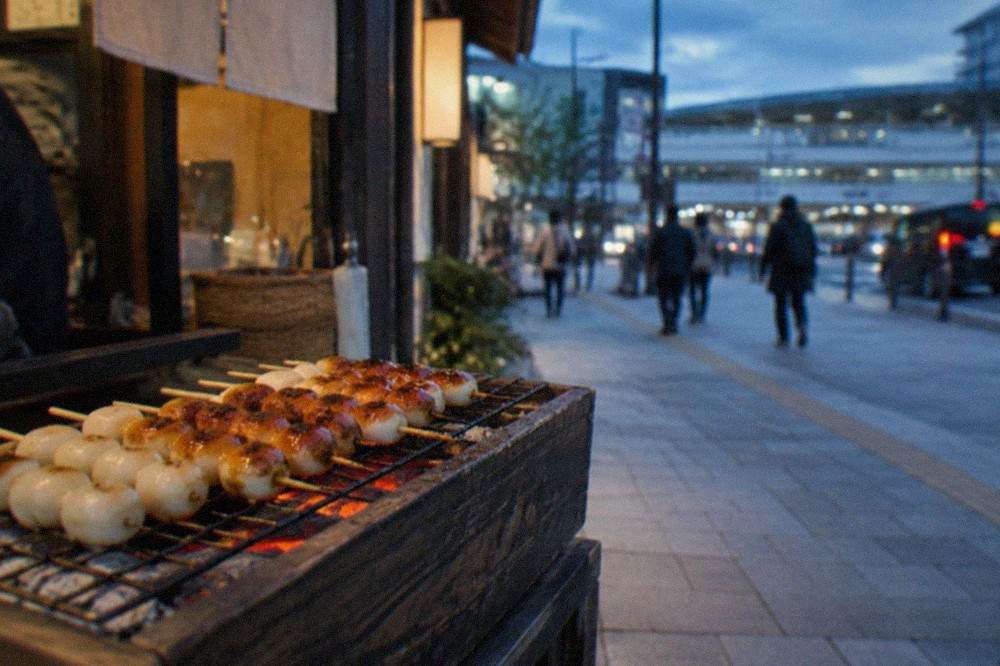
Aburamochi is a skewered dumpling made from mochigome glutinous rice, grilled over charcoal until the surface crisps, then coated in kinako, a powder of roasted soybeans mixed with sugar and a little salt. At Ichimonjiya Wasuke it has been the only product for the shop's entire history, served on the skewer with a small cup of roasted green tea.
The name is honest: abura means oil or fat, mochi means rice cake, and the cooking method is dry grilling over an open flame rather than frying in a pan. The result sits somewhere between a snack and a small meal, warm, faintly smoky, and dusty with the nutty soybean flour that is the signature flavour.
Aburamochi belongs to a family of old Kyoto street sweets that survived because they were tied to pilgrimage routes and temple festivals rather than fashion. If you want to trace that lineage further, the most famous food street in Kyoto and the guide to Kyoto shopping streets cover where those traditions still operate today. What you should not expect is a long menu of variations. The shop's identity is the single recipe, and that singularity is precisely what a thousand years of customers have come for.
One practical note: this site's verified fact pack does not hold the shop's current price, so check the board at the counter rather than any figure quoted in an older guide. Prices for small food businesses in Kyoto move with ingredient costs, and a number copied from a 2024 article may already be wrong.
How Old Is The Shop, Really?
The honest answer is that Ichimonjiya Wasuke traces its founding to the Heian period, and the "1000 years" figure follows from that claim rather than from a dated document this site can verify. The shop's own materials and centuries of local accounts agree on the era, but no founding certificate survives, so treat the round millennium as tradition rather than record.
That hedge matters, because "oldest business" claims in Japan are contested ground. Several Kyoto houses, sake brewers, confectioners and temples-adjacent vendors alike, describe themselves with similar antiquity, and the rankings shift depending on whether you count continuous operation at one site, continuous family ownership, or continuous product. Ichimonjiya Wasuke's claim is strong on all three counts, which is why it usually tops the list when the question is asked in English.
What can be verified is the world around it. The temple it serves, Kiyomizu-dera, opens at 6:00 daily according to the temple's own FAQ, and its adult admission is 500 yen. The shop's survival is inseparable from that flow of visitors, which in 2025 reached a record 62.79 million people across the city, according to the Kyoto City tourism survey released in June 2026. A business with one product and no marketing survives on that kind of footfall.
Where Is The Shop And What Does A Visit Involve?
Ichimonjiya Wasuke stands on Uomachi-zaka, the approach lane that runs from Higashioji-dori up toward Kiyomizu-dera in the Higashiyama district. A visit is a five-minute detour on almost any walk to the temple: arrive from Kiyomizu-dera's main street, turn onto the stone lane, and look for the small wooden frontage with the charcoal grill. Expect to eat standing or on a bench, not at a full restaurant table.
The practical shape of the visit is what surprises people most. There is no ticket, no reservation and no queue system. You order at the counter, take the skewer, and eat it there, because the lane is narrow and the shop has no dining room to speak of. The whole experience can take ten minutes, which is part of the point: this is functioning street commerce, not a heritage performance.
The surrounding fees are worth knowing before you plan the walk, because the verified ones changed recently:
| Site | Adult admission | Notes |
|---|---|---|
| Kiyomizu-dera | 500 yen | Opens 6:00 daily, per the temple's FAQ |
| Kodai-ji | 800 yen | Combined ticket with Entoku-in 1,200 yen |
| Sanjusangen-do | 600 yen | Open every day, 8:30-17:00 April to mid-November |
| Nidec Kyoto Tower | 900 yen | Observation deck 10:00-21:00 |
If you are building a full day around the district rather than a quick stop, how many days in Kyoto is enough covers the wider plan.
Are There Other Ancient Businesses In Kyoto?
Yes, several. Kyoto holds a disproportionate share of Japan's oldest continuously operating companies, including confectioners, sake brewers, knife makers and tea merchants, many founded centuries before the modern era. Ichimonjiya Wasuke is simply the oldest of the publicly accessible ones and the one tied to a famous landmark, which is why the "1000 year old shop" question lands on it.
The pattern has an economic explanation. Kyoto was the imperial capital for over a millennium, it was never flattened by wartime firebombing the way other Japanese cities were, and its economy ran on court patronage, temple pilgrimage and craft trades that rewarded continuity over innovation. Businesses that served those markets had every reason to keep doing exactly what their grandfathers did.
For visitors, the useful framing is this: the aburamochi shop is the headline, but the same streets hold dozens of businesses measured in centuries rather than years. Several of the city's most respected kitchens are old family houses too. Even the famous kaiseki restaurant Hyotei, by Nanzen-ji, prints its own history alongside its menu, and its annex serves a morning rice porridge at 5,445 yen, a centuries-old custom in itself.
A related curiosity: Kyoto also holds the temple with the 1,001 statues, Sanjusangen-do and its 1000 faces, another case where a round number in the question turns out to be a real, verified count, stated by the temple itself.
What Else To See Around The Shop In Kyoto?
Within a ten-minute walk of Ichimonjiya Wasuke you reach Kiyomizu-dera's stage, the preserved slopes of Sannenzaka and Ninenzaka, Kodai-ji and its autumn illuminations, and the start of the Higashiyama walking route toward Gion. The shop sits at the centre of the densest concentration of old Kyoto, so it fits naturally into a half-day circuit rather than being a standalone destination.
The circuit works best in one direction. Come up from Gojo-zaki or Kiyomizu-dera-michi, take the temple first while the crowds are thinner in the early morning, then descend through Sannenzaka and Ninenzaka, where the shop's lane connects, and continue north toward Kodai-ji and Maruyama Park. The city's EX100 and EX101 tourist express buses stop at Gojo-zaka on the Kiyomizu side, at 500 yen for an adult single ride, according to the city transport bureau's fare page, which makes the start of the walk reachable from Kyoto Station without a transfer.
For the evening, the Gion district and whether it is worth visiting covers the geisha district at the end of the same walk, and note the conduct rules: the city's tourism association asks visitors not to touch, chase or photograph geiko and maiko without permission, and signs on Gion's private alleys threaten a 10,000 yen penalty for unauthorized entry or photography. Those signs are district-council signage, not a city police fine, but they are enforced by the community all the same.
Common Questions About Kyoto's 1000 Year Old Shop
What Is The 1000 Year Old Shop In Kyoto?
It is Ichimonjiya Wasuke, an aburamochi sweet shop on Uomachi-zaka, the approach lane below Kiyomizu-dera. By its own account it has operated since the Heian period, selling one sweet, grilled rice cakes on skewers coated in soybean flour.
Is Ichimonjiya Wasuke really a thousand years old?
The shop traces its founding to the Heian period, and no founding document survives to verify a precise date. The millennium figure is the shop's own tradition, widely repeated, and this site treats it as tradition rather than certified record.
What does aburamochi taste like?
It is a warm, chewy rice cake with a lightly charred surface from the charcoal grill, coated in kinako, a roasted soybean flour mixed with sugar and salt. The shop serves it with roasted green tea.
How much does aburamochi cost?
This site's verified fact pack does not hold the shop's current price, so check the board at the counter. Small food businesses in Kyoto adjust prices with ingredient costs, and figures quoted in older guides may be out of date.
Is the shop easy to combine with Kiyomizu-dera?
Yes, it sits on the approach lane a few minutes' walk below the temple, which opens at 6:00 daily and charges 500 yen adult admission. Most visitors pass it on the way down from the temple gate.
Are there other businesses in Kyoto of similar age?
Kyoto holds many companies founded in earlier centuries, including confectioners, sake brewers and tea merchants. Ichimonjiya Wasuke is the oldest publicly accessible one and the one tied to a major landmark, which is why the question usually means it.
The aburamochi shop is a small thing done for a very long time, and that is the whole appeal. Walk up to Kiyomizu-dera early, come down through the stone lanes, buy a skewer, and you have taken part in a transaction that has run on that slope since the era when Kyoto's imperial court was the government of Japan.