What Is The Most Famous Food Street In Kyoto?
Nishiki Market is Kyoto's most famous food street: a 390-metre covered lane of some 130 shops. What to eat, what it costs, and the rules to know before you go.
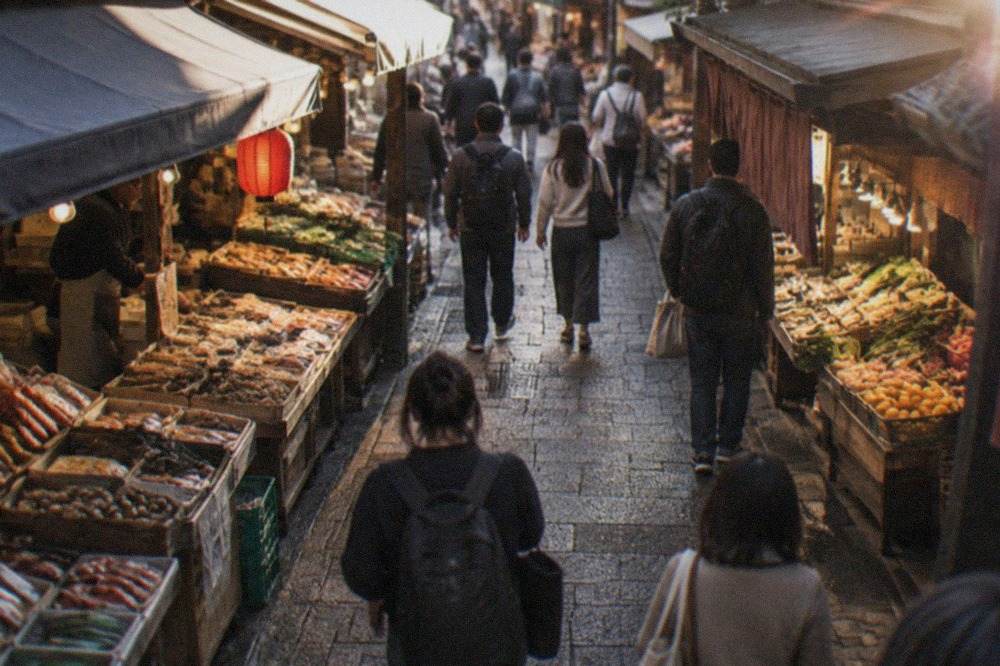
Nishiki Market is the answer to the question, and it is not a close call. Known as Kyoto's Kitchen, it is a covered retail street running roughly east to west, one block north of Shijo-dori in the heart of downtown, packed with specialty food shops that have served the city's restaurants and households for centuries. The lane's own association describes a market of some 130 shops in a corridor a few hundred metres long, and the city's 2025 tourism survey, released 12 June 2026, counted a record 62.79 million visitors to Kyoto overall, a number that explains why this narrow arcade feels the way it does at midday. This page sets out what Nishiki actually is, what to eat there, what it costs, and which other food streets in Kyoto deserve the walk.
What Is The Most Famous Food Street In Kyoto?
Nishiki Market is Kyoto's most famous food street, a covered arcade of roughly 130 specialty shops running parallel to Shijo-dori in central Kyoto. Locals call it Kyoto's Kitchen. It has traded in some form for centuries, supplying the city's restaurants and temples with pickles, tofu, knives and dried goods, and today it doubles as the one food street almost every visitor walks at least once.
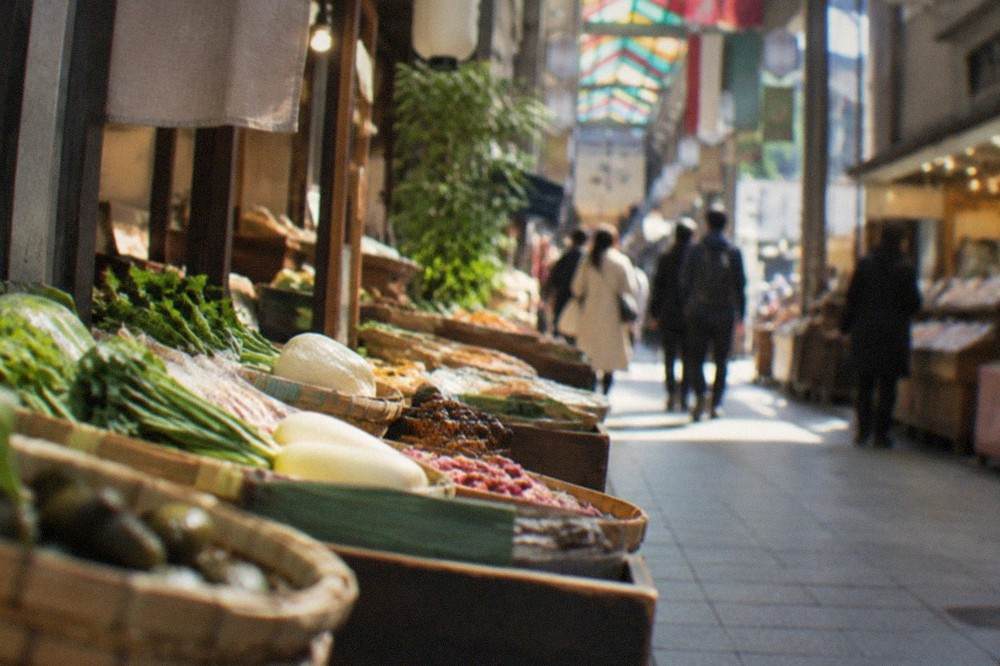
The market's layout is the reason it works. A single roofed lane, entered from Teramachi-dori in the east or Karasuma-dori in the west, holds shops that sell almost nothing but food: pickled vegetables in wooden tubs, soy products in every form, grilled skewers, fresh fish, sweets, tea and the knives used to prepare all of it. Because the street is covered, it functions in rain and in the August heat alike, which matters in a city where the JMA 1991-2020 normals put July rainfall at 223.6 mm, the wettest month of the year.
What Nishiki is not: a night market, and not a street of restaurants. It is a working retail market that happens to be walkable, and its rhythm follows its shops rather than any central schedule. The market association prints no unified opening hours, because there are none to print. Each shop keeps its own, and the honest summary is roughly 9 or 10:00 to 17 or 18:00, with some shops closing on Wednesdays or other irregular days. Any guide that prints a single official opening time for the whole market is inventing one.
For orientation, the market sits inside the downtown core covered in our guide to Kyoto street food, a few minutes' walk from the shopping streets described in which is Kyoto's main shopping street.
Why Is Nishiki Market Called Kyoto's Kitchen?
The nickname comes from the market's original role as the city's wholesale larder. Before Nishiki became a visitor attraction it was where Kyoto's restaurants, temples and households bought pickles, dried fish, tofu and prepared obanzai dishes, the preserved and cured foods a landlocked city needed before refrigeration. The fish shops at its centre began as a strip of fishmongers, and the specialty shops that line it today are the retail descendants of that trade.
That history still shapes what is sold. A large share of the stalls deal in tsukemono, Kyoto's pickled vegetables, because pickling was how the city ate through winter. Tofu and its byproducts, yuba and aburaage, reflect the vegetarian temple cuisine that shaped Kyoto cooking for a millennium. The knife shops, including long-established cutlers, exist because the city's food trades needed blades, and a market that supplied professional kitchens for generations still sells to them.
The visitor economy has changed the balance without erasing it. The city's 2025 survey counted 62.79 million visitors, up from 56.06 million in 2024, and day visitors alone reached 46.20 million. A market this narrow absorbs a large share of that flow, and the shops have adapted: more ready-to-eat items, more English signage, more small portions sold on sticks and in paper cups. The underlying stock, the pickles, the tofu, the tea and the dried goods, is still what the lane trades in.
What Should You Actually Eat On Nishiki Market?
The things worth eating at Nishiki are the things the market has always sold: pickled vegetables by weight, fresh tofu and yuba, tamagoyaki on a stick, grilled scallops and skewers, soy milk doughnuts, matcha and Uji tea sweets, and the fish and obanzai dishes sold by the plate. The reliable strategy is to buy several small items from several shops rather than one meal from one counter, and to treat the lane as a sequence of tastings rather than a restaurant with tables.
A short list of what to look for, and what each item is:
| Item | What it is | Why it belongs to this market |
|---|---|---|
| Tsukemono | Pickled vegetables, senmaizuke and shibazuke among them | The market's founding trade, sold from wooden tubs by weight |
| Yuba and tofu | Soymilk skin and fresh soy products | Kyoto's temple cuisine made these the city's staples |
| Tamagoyaki | Sweet rolled omelette, often on a stick | A classic ready-to-eat market snack |
| Tako tamago | Candied baby octopus with a quail egg inside | One of the lane's most photographed oddities |
| Soy milk doughnuts | Hot, small and cheap | A common shop's signature, best eaten immediately |
| Matcha and Uji sweets | Tea and tea-flavoured confections | Uji, Kyoto's tea district, supplies the city's matcha |
The tea connection deserves a note. Kyoto's matcha culture runs through nearby Uji, and the difference between ordinary matcha and Uji matcha is a real one covered in what sweets Kyoto is famous for. Sweets shops inside Nishiki sell the city's classic confections, and the market is a fair place to try a fresh matcha dessert without committing to a full tea ceremony.
For visitors who want the eating explained rather than just pointed at, a guided food walk turns the lane into a lesson. The Nishiki brunch walking tour with seven tastings, 4.9 from 1,497 reviews at from $74, is built exactly around this street, and the small-group washoku cooking class in our picks band sources its ingredients from the market before teaching the cooking.
How Much Time And Money Does Nishiki Market Take?
Walking the lane end to end takes about 20 to 30 minutes without stopping, but a realistic visit with tastings runs 60 to 90 minutes. There is no entry fee and no minimum spend, so the cost is simply the sum of what you buy: individual snacks at food stalls typically cost a few hundred yen each, and a visitor eating a light meal's worth should expect to spend somewhere in the low thousands of yen. Prices are set by each shop, and no central price list exists.
The honest cost framing for the wider city comes from the one restaurant that publishes its own prices, and it is a useful contrast with the market. Hyotei, a famous kaiseki house by Nanzen-ji, prints on its own site, tax and service included, kaiseki from 31,625 yen at lunch and from 37,950 yen at dinner in the main building, while the same house's annex serves asa-gayu rice porridge at 5,445 yen and a Shokado bento at 7,260 yen, with bookings taken from two people. Those are Hyotei's prices, for those rooms and dates, and they say nothing about what kaiseki costs elsewhere in Kyoto. What they do show is the spread the city offers: a celebrated kitchen's annex under 8,000 yen and its full course above 30,000, with Nishiki's few-hundred-yen snacks at the bottom of the same ladder. Other pages covering the same trip are gathered on Kyoto Travel Guide.
Timing matters more than money. The market is at its most crowded in the middle of the day and on weekends, and the city's own crowd tool, the Kyoto Tourism Comfort Forecast run by the city and its tourism association, publishes a five-level comfort rating for spots and time slots using location data. It is the closest thing to an official answer to the question of when to go, and it beats any invented "best hour" a guide might print.
What Are The Rules For Eating At Nishiki Market?
The rules that matter are the ones about eating while walking and about photography. Stalls at Nishiki ask customers to eat at the stall or in a designated spot rather than walking with food, a request tied to the lane's narrowness and its uncovered food displays. Photography is generally fine, but pointing a camera into a working shop's interior or at staff without asking is unwelcome, and some shops post their own bans. Cash remains useful, as not every small stall takes cards.
The eat-where-you-buy request is the one visitors break most often without realising it. The reasoning is practical rather than precious: a covered lane a few metres wide, with open tubs of pickles and trays of fish, cannot absorb hundreds of people walking with skewers and dripping cups. Buying, stepping to the side of the stall, finishing and moving on is the pattern the shops prefer.
Beyond the market, Kyoto's conduct rules are worth knowing. The city's tourism association publishes four guidelines for the Gion area, no touching or photographing geiko and maiko without permission and no entering private property, and in the private alleys off Hanamikoji, signs posted by the local district council threaten a 10,000 yen penalty for unauthorised photography or entry. Those signs are council signage, not a city police fine, and they are a reminder that the working districts around Kyoto's tourist streets are residential. The etiquette of visiting the city as a whole is covered in our first-time visitor guide to Kyoto.
What Other Food Streets In Kyoto Are Worth Walking?
The strongest alternatives to Nishiki are Pontocho Alley and the Kawaramachi dining district downtown, the restaurant lanes of Gion's Hanamikoji-dori to the east, and Teramachi-dori, which runs directly off the market's east end and holds the Shinkyogoku arcade beside it. None matches Nishiki's density of food retail, but each offers what the market lacks: sit-down restaurants, evening atmosphere and drinking spots that open after the market's shops have closed.
The distinction is worth making plainly. Nishiki is a daytime market that empties by early evening, because its shops close when their owners close them. Kyoto's evening food scene lives a few blocks south and east: the izakaya and bar floors of Kawaramachi, the alley covered in our guide to Kyoto's most famous alley, and the restaurant rows of downtown compared in downtown Kyoto or Gion. Teramachi-dori, described in our Teramachi street guide, is the natural continuation of a Nishiki walk, and it holds the Shinkyogoku arcade beside it.
For visitors who want the evening side of Kyoto eating led by a guide, the Kawaramachi bar and izakaya crawl, 4.9 from 1,042 reviews at from $37 for three hours, moves through exactly this district. It pairs naturally with a daytime Nishiki visit: the market for the tasting walk, Kawaramachi for the night that follows.
Common Questions About Kyoto's Most Famous Food Street
What Is The Most Famous Food Street In Kyoto?
Nishiki Market, a covered arcade of roughly 130 food shops one block north of Shijo-dori. It is known as Kyoto's Kitchen and has supplied the city with pickles, tofu, fish and prepared foods for centuries.
When is Nishiki Market open?
There are no unified hours. Each shop keeps its own, roughly 9 or 10:00 to 17 or 18:00, with irregular individual closures. Any single printed opening time for the whole market is an invention.
Can you eat while walking through Nishiki Market?
Stalls ask you not to. The request is to eat at the stall or in a designated spot, because the lane is narrow and the food displays are open. Buy, step aside, finish, then walk on.
How much does a visit to Nishiki Market cost?
Entry is free. Individual snacks typically cost a few hundred yen each, so a tasting walk through several stalls runs to the low thousands of yen per person. Prices are set shop by shop.
Is Nishiki Market worth it, or too crowded?
The city's 2025 survey recorded 62.79 million visitors to Kyoto, so the lane is busy, particularly midday and at weekends. The Kyoto Tourism Comfort Forecast publishes a five-level crowd rating by time slot, and an early or late-afternoon visit on a weekday is the calmer choice.
Nishiki Market earns its fame honestly: it is a working food market that happens to sit in the middle of one of the most visited cities in Japan, and it still sells what it has always sold. Walk it hungry, eat at the stalls, follow it with an evening in Kawaramachi, and you have eaten Kyoto's most famous street the way the city intends it.