How Long Does It Take To Walk Through Arashiyama Bamboo Grove?
The Arashiyama bamboo grove walk itself is short, but the district around it is not. Here is how to budget your time, what each stop costs, and when the path is quiet.
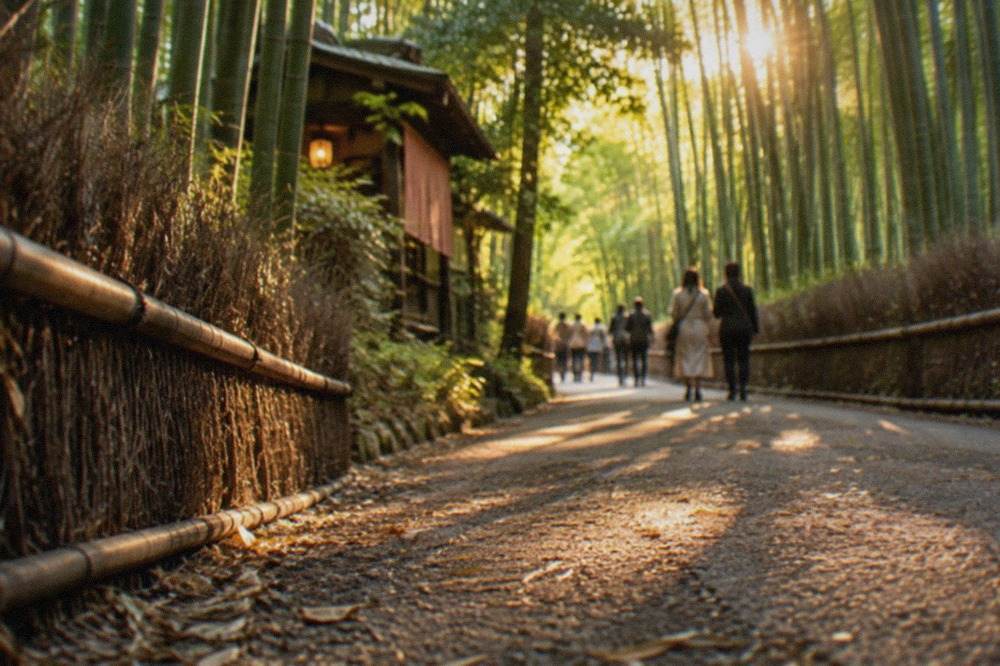
The question sounds like it has a stopwatch answer, and in one sense it does: the bamboo path in Arashiyama is a short, free, public stretch of walkway, and a person moving at a normal pace covers it quickly. The grove is not a hike or a circuit. It is a corridor, one you enter at one end and leave at the other, and the operator-run and city-run attractions stacked around it are what turn a few minutes of bamboo into a half-day outing. That distinction is the whole answer, and the rest of this page breaks it down stop by stop, with the verified fees and hours for each.
How Long Does It Take To Walk Through Arashiyama Bamboo Grove?
The bamboo grove path itself is a brief walk, typically a matter of ten to twenty minutes at a relaxed, photo-stopping pace, because it is a short free public corridor rather than a trail with a set length. No operator publishes an official duration, and none is needed: the path is open around the clock, costs nothing, and takes as long as you let it. What stretches the visit is everything you attach to it.
The grove is the classic example of an attraction that is smaller than its reputation and richer than its photographs. People arrive expecting a forest and find a corridor. The stalks are tall, the light through them changes by the hour, and the path connects directly into the wider Arashiyama district, so the walk ends and the visit continues whether you planned for it or not.
A useful way to think about it: the grove is the hinge of Arashiyama, not the door. Tenryu-ji sits at one end of the area, the Katsura River and Togetsukyo bridge at the other, and the bamboo path runs between them near the top of the slope. Most itineraries flow through the grove on the way from one cluster of sights to another, which is why the walk feels longer in memory than it is on a map.
If you want the full district picture, the Arashiyama area guide lays out the neighbourhood street by street, and the bamboo grove attraction page covers the path itself in detail.
How Much Time Should You Budget For Arashiyama Overall?
For the bamboo grove plus its immediate neighbours, budget two to three hours. For the fuller Arashiyama circuit, including the monkey park, a temple garden and the river, budget half a day, roughly four to five hours. The city's own tourism numbers explain why the buffer matters: Kyoto recorded 62.79 million visitors in 2025, a record, and the grove is on nearly every first-time itinerary.
The two-to-three-hour version covers the grove, the Tenryu-ji garden next to it, and a walk down to Togetsukyo bridge. The half-day version adds Iwatayama Monkey Park, which is a genuine uphill walk of around twenty minutes to reach the summit enclosure, plus the riverfront. The monkey park's own site sets its hours at 9:00 to 16:00, with the summit closing at 16:30, and it closes early in bad weather or when the monkeys head back up the hill, so it belongs in the morning half of your day.
Guided tours give a calibrated benchmark for the full circuit. The Arashiyama walking tour with monkeys, temple and garden runs five hours and covers the grove, the monkey park and a temple garden, rated 5 from 1,781 reviews. An operator selling a five-hour product around the district is telling you something the free path cannot: the district is the draw.
What Does Each Arashiyama Attraction Cost And Add In Time?
Each stop around the grove carries its own fee and its own time cost: the bamboo path is free, the Tenryu-ji garden is 500 yen, the monkey park is 800 yen for visitors 16 and over, and the Sagano Romantic Train is 880 yen one way for adults. The fees are small; the walking between them is what consumes the hours, because Arashiyama spreads along a river valley and a slope.
Here is the verified breakdown, with each figure taken from the operator's or venue's own published rates.
| Stop | Admission | Time it adds |
|---|---|---|
| Bamboo grove path | Free, no closing time published for the path | 10-20 minutes walking, more with photos |
| Tenryu-ji garden | 500 yen high school and up, 300 yen elementary and junior high | 45-60 minutes |
| Tenryu-ji buildings | Garden fee plus 300 yen | Adds 20-30 minutes |
| Iwatayama Monkey Park | 800 yen for 16 and over, 400 yen for ages 4-15 | 1.5-2 hours including the uphill walk |
| Sagano Romantic Train | 880 yen adult one way, 440 yen child | 25 minutes riding, plus queue time |
| Hozugawa Kudari river boat | 6,000 yen adult, 4,500 yen child | About 2 hours |
A note on two of those rows. The Sagano Romantic Train's standard one-way fare is 880 yen for adults, defined as 12 and over, and 440 yen for children aged 6 to 12, with toddlers free when accompanied, per the operator's own ticket page. The Hozugawa Kudari boat is 6,000 yen for an adult and 4,500 yen for a child from infant to elementary age, on scheduled shared boats of 24 seats, running its regular timetable from 10 March to 13 December 2026. The widely repeated figure of around 4,100 yen for the boat is stale; the operator's current ticket page is the one to trust. More of these guides are collected on Kyoto Travel Guide.
The money side of a full Arashiyama day stays modest even at the top end. The garden, the monkey park and the train each charge only a few hundred yen to under a thousand, and the river boat is the one line item that changes the budget. What you cannot buy back is time: the monkey park's uphill approach and the boat's two-hour runtime are fixed costs, and neither compresses.
When Is The Bamboo Grove Least Crowded?
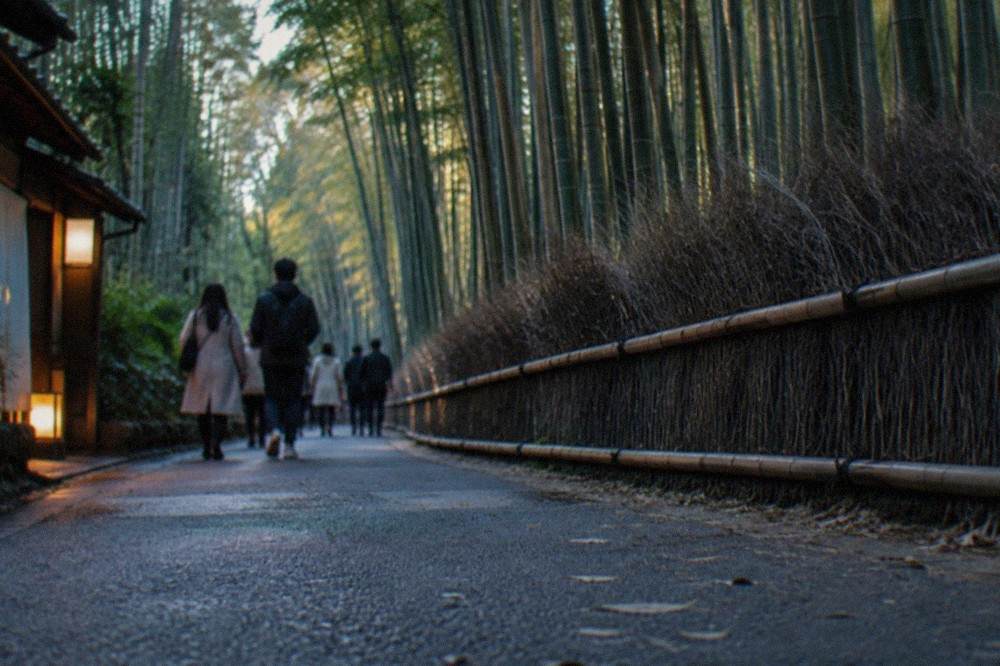
Early morning, before 8:00, is the quiet window, and the last hour before dusk is the second-best option. The grove has no closing time and no entry gate, so the crowd pattern is purely a function of arrival habits. Kyoto's 2025 survey recorded 62.79 million visitors across the year, and the city's own crowd-management programmes now explicitly push tourists toward mornings, evenings and lesser-known spots.
The arithmetic is unforgiving at the peak. Mid-morning through mid-afternoon, the path carries a steady two-way flow of tour groups, and the narrow sections slow to a shuffle. The difference between 7:30 and 10:30 is not subtle; it is the difference between hearing the bamboo creak and hearing commentary in six languages. The Kyoto crowds guide covers the city-wide patterns, including the tourism comfort forecast the city runs from smartphone location data.
There is a second, quieter argument for early arrival that has nothing to do with crowds. The monkey park opens at 9:00, the Tenryu-ji garden at 8:30, and the Sagano train's first departures sit near the start of its morning schedule. Arriving before 8:00 lets you take the grove at its emptiest, then walk straight into the paid attractions as they open, which is the most efficient ordering the district allows.
The trade-off is light. Bamboo photographed at dawn is dim and green and moody; bamboo at noon is bright and flat. If the photographs matter more than the solitude, late afternoon serves both, and the grove's lack of a gate means you can pass through it twice, once for the quiet and once for the pictures.
Can You Extend The Walk Beyond The Bamboo?
Yes, and most people should, because the grove connects directly into longer walking routes: up to Iwatayama Monkey Park, along the Katsura River to Togetsukyo bridge, or out along the Sagano railway corridor toward the Hozugawa Kudari boat landing. A walker who treats the grove as a starting point rather than a destination can fill a full day in Arashiyama without repeating a street.
The classic extension is the loop that takes in the grove, the monkey park, and the riverfront, and it is exactly the shape the five-hour guided tours follow. Going north instead, the Hozugawa river boat runs about two hours down the valley, and the Sagano Romantic Train runs the opposite direction along the same gorge, so the two can be combined into a boat-and-train pairing that turns Arashiyama into a full-day destination with a single transit decision.
For visitors who would rather not self-direct the circuit, the guided options split cleanly by depth. The walking tour above covers Arashiyama at ground level over five hours. The one-day bus tour that pairs Fushimi Inari, Kinkaku-ji and the bamboo grove squeezes the grove into a highlights circuit, from $97 and rated 4.8 from 5,317 reviews, which tells you the grove gets a short slot. The early-morning tour with an English-speaking guide, from $82 and rated 4.9 from 1,998 reviews, is built around exactly the timing logic above: beat the crowds to the famous paths.
If Arashiyama is one stop on a longer Kyoto plan rather than a destination in itself, the wider question of how many days the city deserves has its own answer, and the first-time visitor guide is the place to work it out.
Common Questions About The Arashiyama Bamboo Grove Walk
How long does it take to walk through Arashiyama bamboo grove?
The path itself takes most walkers ten to twenty minutes at a relaxed pace with photo stops. It is a short, free, open corridor rather than a trail, so the duration is entirely in your control. Budget two to three hours for the grove plus its immediate neighbours, or half a day for the fuller circuit with the monkey park and riverfront.
Is the Arashiyama bamboo grove free to enter?
Yes. The grove is a free public path with no gate and no published closing time. The paid attractions sit around it: Tenryu-ji's garden at 500 yen, the monkey park at 800 yen for visitors 16 and over, and the Sagano Romantic Train at 880 yen one way for adults.
What is the best time of day to visit the bamboo grove?
Before 8:00, when the tour groups have not yet arrived and the path is at its quietest. Late afternoon is the second-best window. The grove's lack of an entry gate means you can walk it twice in one day, once for the quiet and once for the light.
Can you visit Arashiyama and the monkey park in one morning?
Yes, if you start early. The monkey park opens at 9:00 and closes its gate at 16:00, with the summit area until 16:30, and the uphill walk to the enclosure takes around twenty minutes. A 7:30 start at the grove, Tenryu-ji at 8:30, and the monkey park at opening fits comfortably into a morning.
Is the bamboo grove walk suitable for children and strollers?
The grove path itself is a paved, level public walkway with no gates or stairs, so it works for strollers and small children. The monkey park is the opposite: a genuine uphill trail of around twenty minutes. The Sagano Romantic Train and the Hozugawa Kudari boat both carry children at reduced fares, 440 yen and 4,500 yen respectively.
The short version, then: the bamboo takes minutes, Arashiyama takes hours, and the gap between those two numbers is where the district earns its place on your itinerary. Walk the grove early, walk it slowly, and let the rest of the valley decide how long you stay.