Which Kyoto Sights Are Free: Fushimi Inari, Yasaka, Nanzen-ji Grounds, Imperial Palace?
Kyoto is not a cheap city, but its most famous sight costs nothing at all, and half its best experiences are free. Here is what genuinely charges, what genuinely does not, and how to keep the damage small.
Short answer
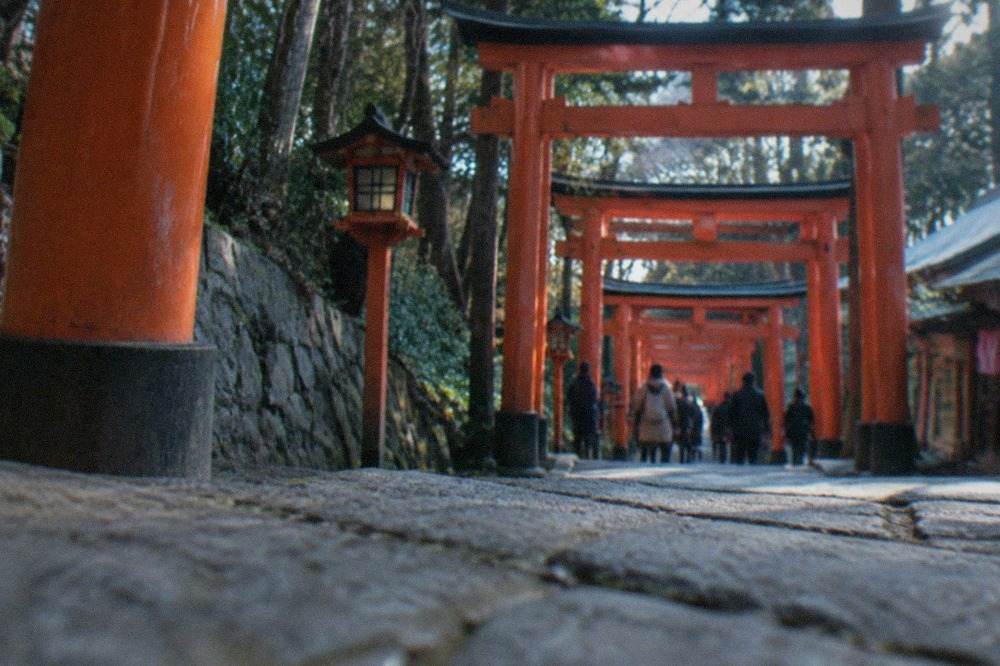
Fushimi Inari Taisha, Yasaka Shrine, the Nanzen-ji grounds, the Kyoto Imperial Palace, the Arashiyama bamboo path, Nishiki Market and the Philosopher's Path are all free to enter. The paid sights are the temples and gardens, where fees run 500 to 1,300 yen, and two of them changed their prices this year.
Which Kyoto Sights Are Free: Fushimi Inari, Yasaka, Nanzen-ji Grounds, Imperial Palace?
Kyoto drew a record 62.79 million visitors in 2025, according to the city's own tourism survey released in June 2026, and most of them left with the same surprise: the single most famous sight in the city costs nothing. Fushimi Inari Taisha, the head shrine of about 30,000 Inari shrines nationwide, publishes no admission fee anywhere on its site, and its mountain paths have no closing time. That is the anchor of any budget trip here, and it is not alone. This guide separates what is genuinely free from what merely looks free, prints the temple fees straight from the venues' own notices, and builds a realistic daily budget from the city's own published fares and tax rules.
Which Kyoto Sights Are Free: Fushimi Inari, Yasaka, Nanzen-ji Grounds, Imperial Palace?
Fushimi Inari Taisha, Yasaka Shrine, the Nanzen-ji grounds, the Kyoto Imperial Palace, the Arashiyama bamboo path, Nishiki Market and the walking districts of Gion, Pontocho and the Philosopher's Path are all free to enter, with no ticket, no reservation and no suggested donation. Only the interior sub-temples and gardens at Nanzen-ji charge, while the shrine, the palace and the market cost nothing at all.
Start with the four in the question. Fushimi Inari is the clearest case: the shrine's own FAQ page lists no fee, and the roughly 10,000 torii it mentions are spread across the whole mountain, not just the famous Senbon Torii tunnel. The Kyoto Imperial Palace, on the Imperial Household Agency's English page, states it is "open to all visitors" and that "no advance application is necessary". Yasaka Shrine in Gion has no gate to charge at. Nanzen-ji is the one with a catch: the precinct itself, the Sanmon gate's exterior, the aqueduct and the approach are free to walk, but the Hojo garden (600 yen) and the Sanmon gate's upper platform (600 yen) are ticketed separately, as the temple's own visit page sets out.
Two free sights carry restrictions worth knowing before you plan. The Shugakuin Imperial Villa and the Sento Imperial Palace are free but guided-only, and both admit 18 and over only, with under-18s, including infants, not admitted. Katsura Imperial Villa charges 1,000 yen for those 18 and over, is free for 12 to 17, and runs a roughly 60-minute guided tour by advance online application or same-day numbered ticket with ID, closed Mondays. For a family, that age rule is the difference between a free morning and a locked gate.
For a fuller walk through the free side of the city, our free things to do in Kyoto guide covers the shrines, riverbanks and hillside paths in detail, and the Fushimi Inari shrine page explains the full mountain circuit, which the shrine gives as 233 m at Inariyama.
How Much Does A Day In Kyoto Actually Cost?
A lean day in Kyoto can be built almost entirely from the city's published prices: 230 yen per bus ride or 1,100 yen for the Subway and Bus One-Day Pass, 500 to 1,300 yen for admission at one or two paid temples, and free sights filling every gap. The biggest hidden cost is the accommodation tax, which changed on 1 March 2026 and now runs up to 10,000 yen per person per night on the most expensive rooms.
The city's transport bureau publishes the numbers that make this work. A city bus ride is a flat 230 yen for adults, the subway runs 220 to 360 yen by zone, and the Subway and Bus One-Day Pass is 1,100 yen for adults and 550 for children. The old bus-only one-day pass no longer exists: sales ended in September 2023 and it stopped being usable on 31 March 2024, so any guide still recommending it is three years stale. The pass breaks even at roughly four bus rides, which a typical Higashiyama day easily exceeds.
The accommodation tax is the line item most budgets miss. From 1 March 2026, the city's revised ordinance charges 200 yen per person per night on rooms under 6,000 yen, 400 yen on 6,000 to under 20,000, 1,000 yen on 20,000 to under 50,000, 4,000 yen on 50,000 to under 100,000, and 10,000 yen at 100,000 and up. The tax applies to the room-only charge, excluding meals and consumption tax, and the city expects about 12.6 billion yen a year from it. For a budget traveller in an inexpensive hostel room, the tier matters more than the total.
| Cost item | Verified price | What it buys |
|---|---|---|
| City bus, single ride | 230 yen adult, 120 yen child | flat fare anywhere in the city |
| Subway, zones 1-5 | 220 to 360 yen adult | longest single ride under two bus fares |
| Subway and Bus One-Day Pass | 1,100 yen adult, 550 yen child | unlimited bus and subway; breaks even at about 4 bus rides |
| EX100 / EX101 tourist express | 500 yen adult, 250 yen child | faster Kyoto Station to Kiyomizu runs; covered by the pass |
| Temple admission, one site | 500 to 1,000 yen | Kinkaku-ji 500, Ryoan-ji 600, Ginkaku-ji 1,000 |
| Temple admission, combined | 1,200 to 1,300 yen | Kodai-ji plus Entoku-in 1,200; Nijo-jo with Ninomaru-goten 1,300 |
| Free sights | 0 yen | Fushimi Inari, Yasaka, Nanzen-ji grounds, Imperial Palace, bamboo path, Nishiki Market |
The EX100 and EX101 tourist express buses, at 500 yen for adults per ride, are worth the premium when you are moving between Kyoto Station and the Kiyomizu side, because they skip the local stops. They are covered by the one-day pass too, which the city's transport bureau confirms on its limited-express page.
If you are weighing Kyoto against its neighbour, our one day in Kyoto itinerary shows how much free sightseeing fits into a single, tightly planned day, and Kyoto Travel Guide covers the full planning picture.
What Do Kyoto Temples Charge, And Which Fees Rose In 2026?
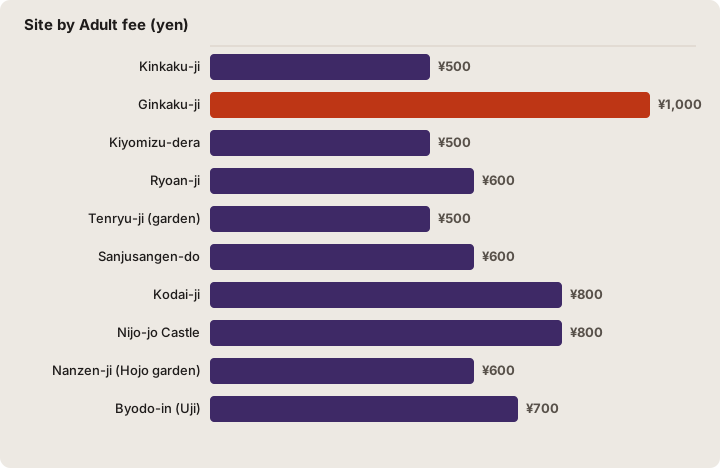
Kinkaku-ji charges 500 yen for adults, Ryoan-ji 600, Tenryu-ji's garden 500, Sanjusangen-do 600, Kodai-ji 800 and Nijo-jo Castle 800 or 1,300 with the Ninomaru-goten Palace. Ginkaku-ji doubled to 1,000 yen for adults from 1 April 2026, its first rise in 32 years, and Tofuku-ji revises on 1 November 2026, with its Hojo garden going from 500 to 600 yen and a new 1,000 yen combined ticket.
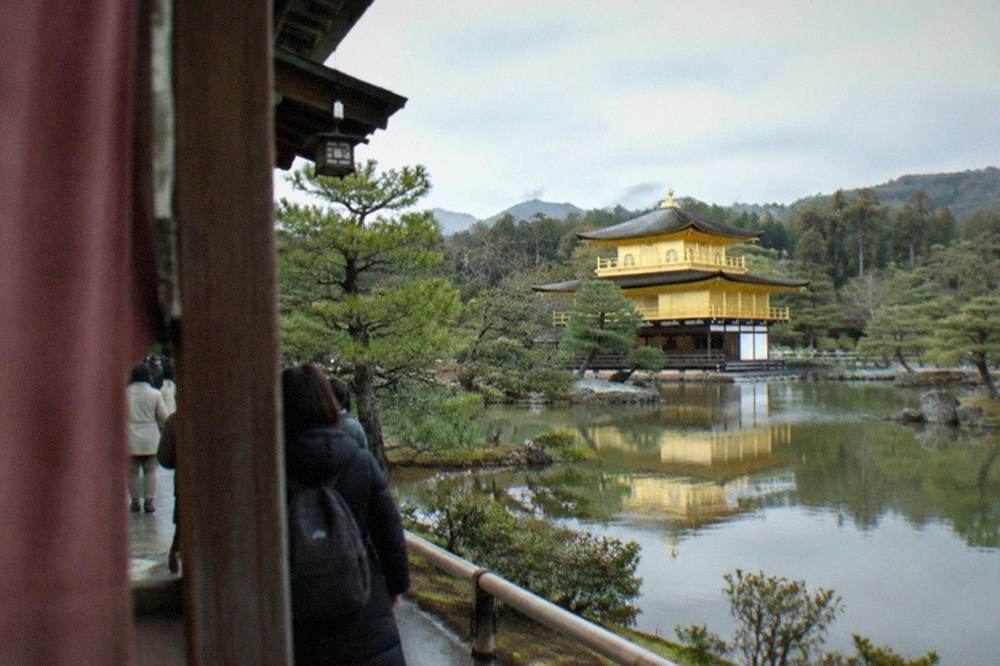
The 2026 changes are the reason to check the date on any fee list you are reading. The Shokoku-ji headquarters, which administers both pavilions, posted the Ginkaku-ji notice in January 2026: adults went from 500 to 1,000 yen and children from 300 to 500. Kinkaku-ji, by contrast, last raised its fee on 1 April 2023 and has posted no change since, so the golden pavilion still costs half of what the silver one does. For a first visit, that makes Kinkaku-ji the better use of a fee, a judgement the numbers support on their own.
Tofuku-ji's revision is the sneaky one. The temple's own notice, linked from its site, sets the Hojo garden at 600 yen from 1 November 2026 (up from 500), introduces a 1,000 yen combined ticket for the Tsutenkyo bridge and Kaisando together, and, during the autumn foliage period, prices the bridge and Kaisando at 1,000 yen for adults. Anyone visiting in late November on an older price list will be under-budgeted at exactly the moment the temple is most crowded.
| Site | Adult fee | Child / student fee | Change status |
|---|---|---|---|
| Fushimi Inari Taisha | free | free | none |
| Kinkaku-ji | 500 yen | 300 yen (primary and middle school) | none since April 2023 |
| Ginkaku-ji | 1,000 yen | 500 yen | doubled from 500 on 1 April 2026 |
| Kiyomizu-dera | 500 yen | 500 yen (high school) | figure not printed by the temple; single source |
| Ryoan-ji | 600 yen | 500 high school, 300 elementary and junior high | none |
| Tenryu-ji (garden) | 500 yen | 300 yen | none; buildings plus 300, Hatto ceiling 500 separately |
| Sanjusangen-do | 600 yen | 400 junior high and high school, 300 elementary | none |
| Kodai-ji | 800 yen | 400 junior high and high school | none; 1,200 combined with Entoku-in |
| Nijo-jo Castle | 800 yen | 400 junior high and high school, 300 elementary | none; 1,300 with Ninomaru-goten |
| Nanzen-ji (Hojo garden) | 600 yen | 500 high school, 400 elementary and junior high | none; Sanmon gate ticketed separately |
| Byodo-in (Uji) | 700 yen | 400 junior high and high school, 300 elementary | none; Phoenix Hall interior plus 300 |
| Tofuku-ji (Tsutenkyo and Kaisando) | 600 yen | 300 yen | 1,000 yen during foliage period from 1 Nov 2026 |
One caution on Kiyomizu-dera: the 500 yen figure is widely reported but the temple does not print it on its own site, so treat it as a planning number rather than an official one. The temple's FAQ does confirm it opens at 6:00 daily, with closing times that shift by season and extend to 21:30 during the spring and autumn night viewings.
A paid day-tour can undercut the DIY version once you add up admissions and transport. The Fushimi Inari, Kinkakuji, Bamboo Grove 1-Day Bus Tour covers three of the headline sights in one loop, from $97 per person, rated 4.8 across 5,317 reviews, and runs 8.5 to 9 hours.
How Do You Get Around Kyoto Cheaply?
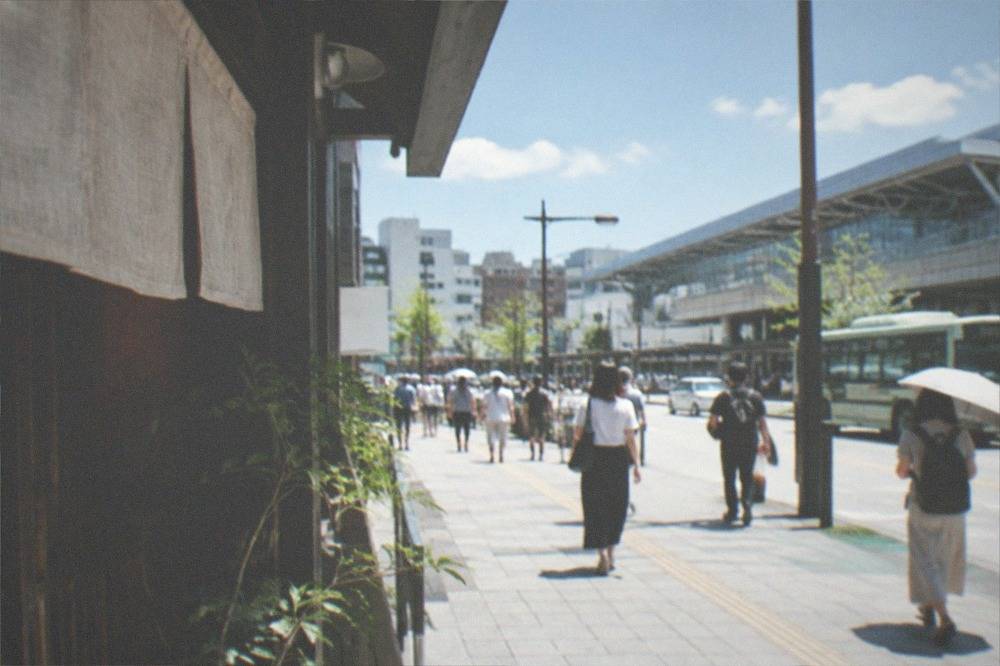
A flat 230 yen city bus fare, a 220 to 360 yen subway range and the 1,100 yen Subway and Bus One-Day Pass are the whole system for a visitor, and the pass pays for itself at about four bus rides. The tourist express buses EX100 and EX101 cost 500 yen a ride, and the HARUKA one-way visitor ticket from Kansai Airport is 2,200 yen, far below the regular fare.
The transport bureau's own fare pages give every number above. Children pay 120 yen on the bus and 550 yen for the pass. The subway's zone 1 to 5 ladder runs 220, 260, 290, 330 and 360 yen for adults, so even the longest single ride costs less than two bus trips.
The airport transfer is where budgets bleed, and the JR West visitor ticket fixes it. The HARUKA One-way Ticket, sold to foreign visitors, prices the run from Kansai Airport to Kyoto at 2,200 yen for adults and 1,100 for children, with the journey taking about 80 minutes. From Itami Airport on the Osaka side, the limousine bus is 1,500 yen for adults and takes 50 to 55 minutes to Kyoto Station's Hachijo exit, with contactless card payment accepted since 1 March 2026.
| Transport | Adult fare | Notes |
|---|---|---|
| Kyoto City Bus, flat | 230 yen | child (6-11) 120 yen |
| Subway, zones 1-5 | 220 to 360 yen | child 110 to 180 yen |
| Subway and Bus One-Day Pass | 1,100 yen | child 550 yen; breaks even at about 4 bus rides |
| EX100 / EX101 tourist express | 500 yen | child 250; covered by the one-day pass |
| HARUKA visitor one-way, KIX to Kyoto | 2,200 yen | child 1,100 yen; about 80 minutes |
| Itami limousine bus to Kyoto Station | 1,500 yen | child 750 yen; 50 to 55 minutes |
| ICOCA card | 2,000 yen with 500 yen deposit | usable on bus, subway and JR |
The city has also been reorganising its buses around overtourism, adding tourist express routes and promoting hands-free luggage delivery to keep suitcases off crowded vehicles; drivers may refuse bulky luggage on packed buses. The details, and the crowd-forecast tool the city runs, are in our Kyoto crowds guide.
Where Can You Eat Well In Kyoto Without Paying Kaiseki Prices?
At Hyotei, one of Kyoto's most famous kaiseki houses by Nanzen-ji, the kaiseki course itself starts at 31,625 yen at lunch and 37,950 yen at dinner, but the same restaurant's annex serves morning rice porridge at 5,445 yen and a shokado bento at 7,260 yen. That gap is the whole budget strategy: the same kitchens, the same ingredients, a fraction of the price, at a different hour.
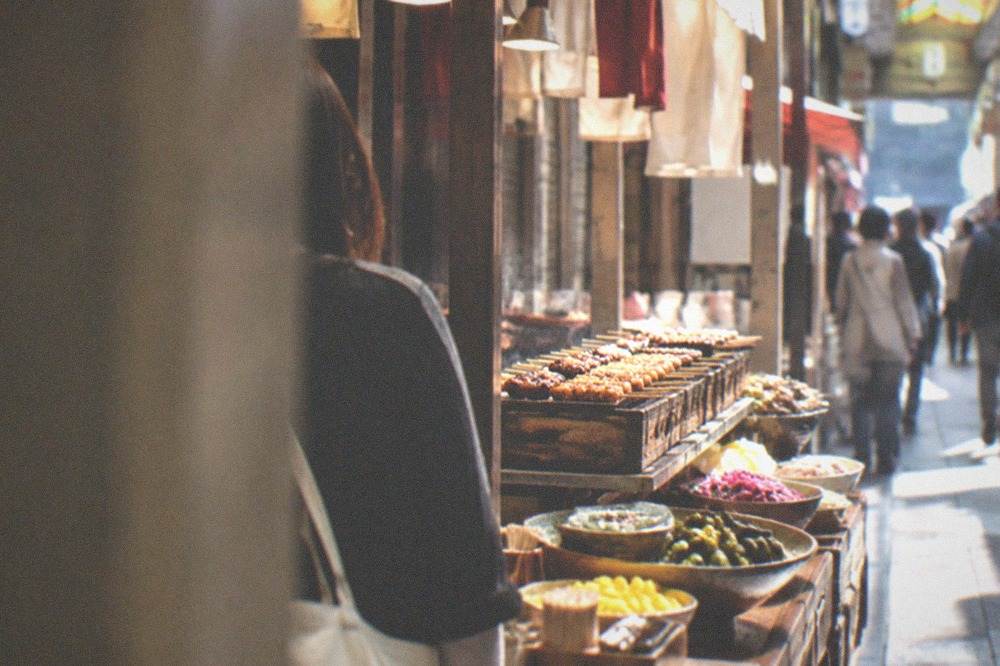
Hyotei's own front page prints those prices, tax and service included, and they are Hyotei's prices alone, never a Kyoto average. The lesson generalises. Nishiki Market has no unified hours, because each shop keeps its own, generally from about 9 or 10:00 to 17 or 18:00, but the market association asks visitors not to eat while walking, and to eat at the stall where they bought. A market brunch of skewers, tofu and pickles sidesteps restaurant pricing entirely.
The other reliable lever is the lunch set, served across the downtown grid at a discount to the same kitchens' dinner menus. Department-store basement food halls at Kyoto Station close out sushi and bento in the early evening. And the budget classics, udon, soba and curry houses, sit at the cheap end of every downtown street; check the menu board before sitting, because prices are posted at the door as a rule.
For depth, our Kyoto tofu and shojin-ryori page covers the temple-cuisine tradition, which is where some of the best-value set lunches in the city live, and the Kyoto neighborhoods guide maps which districts hold the cheap eating streets.
Which Free Walks And Cheap Tours Are Worth Booking?
The best-value guided options in Kyoto are the free, tip-based walking tours on GuruWalk, where a local guru leads a roughly three-hour route and you pay what you choose, and the small paid walks from about 20 to 30 dollars, such as the Gion geisha walks. For a full day, the one-day bus tours from about 97 to 102 dollars bundle transport and several sights, which often costs less than doing the same loop independently.
The free-walk scene deserves the honesty label more than most. GuruWalk's Free Walking Tour Kyoto, rated 4.93 across 1,128 reviews, runs about three hours, and the guru leading it, a local guide working for tips rather than a wage, decides the route and the pace. It is not this site's tour and that is exactly why it can be named: the platform, GuruWalk, is where the booking happens, and the tip is the whole price. There are Gion, Higashiyama and historic-centre variants, each about two to three hours.
On the paid side, the short walks are cheap enough to be impulse decisions: Gion geisha and hidden-gems walks run from about 20 to 30 dollars for two hours, with the top-rated options carrying thousands of reviews. The Fushimi Inari Hidden Hiking Tour, from $73 and rated 5 across 1,931 reviews, is the mid-range pick, taking the mountain's quieter back trails rather than the crowded tunnel; the tour's own page has the route detail, and our Fushimi Inari hiking time answer covers the DIY version.
For food, the Nishiki Market brunch walking tour at $74 with seven tastings effectively replaces lunch, which changes its real cost. The arithmetic is the thing to check on any tour: a day tour that includes transport and one or two admissions is often close to the independent total, with a guide thrown in.
When Is Kyoto Cheapest To Visit?
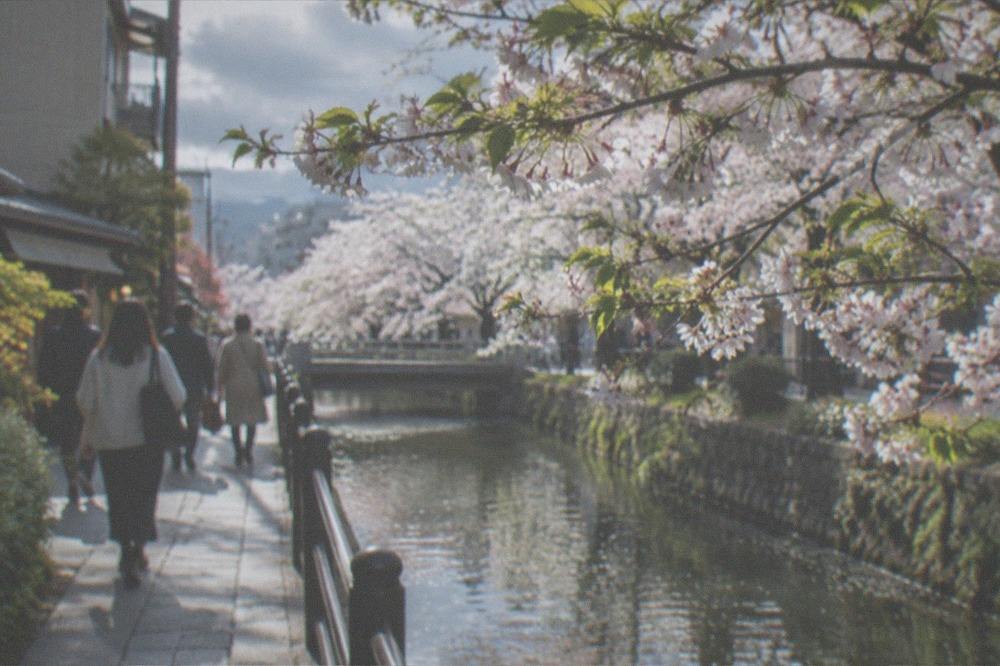
Late November to early March is the cheapest time in Kyoto, outside the foliage peak, with January the coldest month at a mean of 4.8 C and the driest at 53.3 mm of rain. The expensive windows are late March to mid-April for cherry blossom, which reached full bloom on 30 March in 2026, three to five days ahead of the 1991-2020 normal, and late November for autumn leaves, which the JMA observatory dates to 10 December in 2025.
The Japan Meteorological Agency's normals for station 47759 give the honest picture. July, not June, is Kyoto's wettest month at 223.6 mm, and August is the hottest at a mean of 28.5 C with a mean daily high of 33.7 C. Summer hotel rates dip even as the heat peaks, but the value season is winter: January combines the lowest rainfall, the thinnest crowds and the lowest prices, and the free sights, Fushimi Inari, the shrines, the Philosopher's Path, are open regardless of temperature.
| Month | Rain (mm) | Mean temp (C) | Budget verdict |
|---|---|---|---|
| January | 53.3 | 4.8 | cheapest, coldest, driest |
| February | 65.1 | 5.4 | cheap, quiet, dull light |
| March | 106.2 | 8.8 | rates climb toward blossom season |
| April | 117.0 | 14.4 | peak pricing around full bloom |
| July | 223.6 | 27.3 | wettest month; summer discounts but heavy rain |
| August | 153.8 | 28.5 | hottest month; indoor afternoons |
| November | 73.9 | 12.5 | foliage premium, especially late month |
| December | 57.3 | 7.2 | value returns after early December |
The phenology record matters for timing. The JMA's Kyoto observatory logged cherry flowering on 23 March 2026 and full bloom on 30 March, against normals of 26 March and 4 April, so the blossom window has been running early. Maple red leaves at the observatory's specimen tree came on 10 December in 2025 against a 5 December normal, later than the mid-November peak most guides claim for Arashiyama.
How Can You See The Paid Sights For Less?
The reliable tactics are the temple's own cheaper sub-tickets (Tenryu-ji's garden without the buildings saves 300 yen, Nanzen-ji's grounds without the Hojo garden saves 600), the free imperial properties that outclass many paid gardens, the night-illumination hours that bundle several sites into one ticketed evening, and the combined tickets, such as Kodai-ji plus Entoku-in at 1,200 yen, that discount two sights into one.
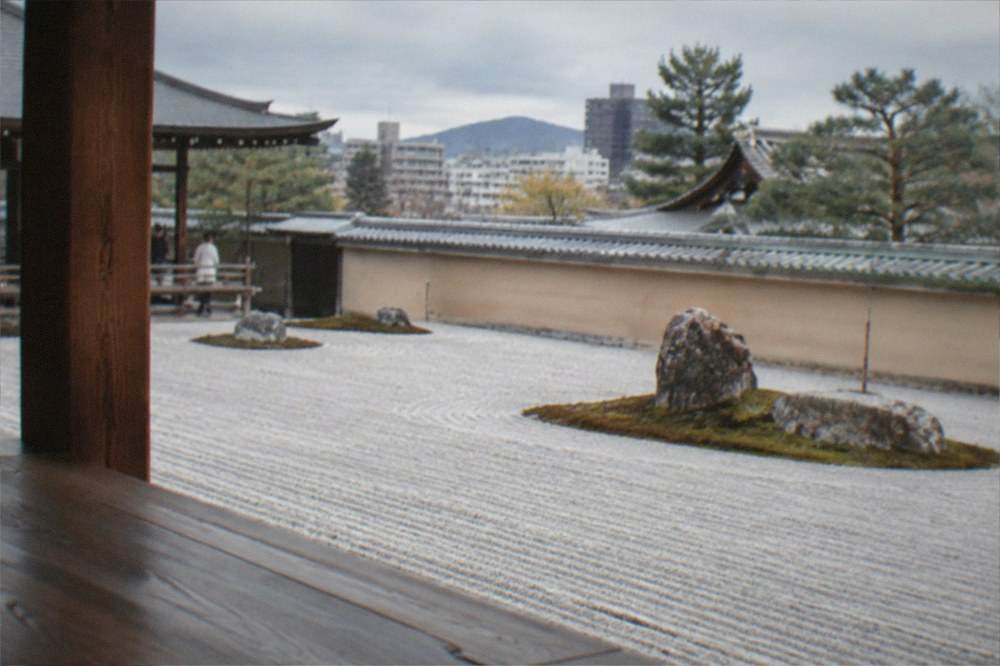
Pick your pavilion with the fee table in mind. Ginkaku-ji at 1,000 yen is now twice Kinkaku-ji's 500, and the two experiences are closer in quality than the prices suggest. Ryoan-ji's rock garden at 600 yen and Sanjusangen-do's 1,001 Kannon statues at 600 yen, a count the temple itself states, are two of the strongest fee-to-impact ratios in the city. Byodo-in in Uji, at 700 yen plus 300 for the Phoenix Hall interior, pairs naturally with a day trip on the JR Nara Line at 240 yen each way.
The imperial properties are the budget sleeper. The Kyoto Imperial Palace is free and needs no application; the Imperial Palace page has the access detail. Shugakuin Imperial Villa is free, guided, and one of the finest stroll gardens in Japan, provided everyone in your party is 18 or over. Katsura, at 1,000 yen for adults, is still cheaper than most temple-garden combinations.
Time-shift where you can. Kiyomizu-dera opens at 6:00, and the first hour belongs to almost nobody. The Kodai-ji night illumination, 17:00 to 22:00 with reception to 21:30, runs 23 October to 13 December in 2026, and the temple's own pages list it. For the Philosopher's Path and Nanzen-ji, the walk between them is free and the aqueduct is one of the city's better photo spots, as our Kyoto photo spots guide notes.
First-time visitors should read the first-timers itinerary before locking a plan, because the mistake that costs the most in Kyoto is not any single fee, it is criss-crossing the city and paying transport twice.
Common Questions About Kyoto On A Budget
Which Kyoto sights are free: Fushimi Inari, Yasaka, Nanzen-ji grounds, Imperial Palace?
Fushimi Inari Taisha, Yasaka Shrine, the Nanzen-ji precinct and the Kyoto Imperial Palace are all free, with no ticket or reservation. Fushimi Inari publishes no fee anywhere on its site and its paths have no closing time; the palace states it is open to all with no advance application. At Nanzen-ji, only the Hojo garden and Sanmon upper platform charge, at 600 yen each.
Is Fushimi Inari really free?
Yes. The shrine's own FAQ page lists no admission fee, and nobody collects one. The roughly 10,000 torii the shrine mentions are spread across the whole mountain, and the full circuit of Inariyama, which the shrine gives as 233 m, costs nothing but time and effort.
What is the cheapest way to get around Kyoto?
The flat 230 yen bus fare and the 220 to 360 yen subway range cover most needs, and the 1,100 yen Subway and Bus One-Day Pass breaks even at about four bus rides. The bus-only one-day pass no longer exists; its sales ended in September 2023 and it stopped being usable on 31 March 2024.
How much is the Kyoto accommodation tax?
From 1 March 2026 it is 200 yen per person per night on rooms under 6,000 yen, 400 yen up to 20,000, 1,000 yen up to 50,000, 4,000 yen up to 100,000, and 10,000 yen at 100,000 and above. It applies to the room-only charge, excluding meals and consumption tax.
Can you visit Kyoto without paying any temple fees?
Yes, and without missing much. Fushimi Inari, Yasaka Shrine, the Imperial Palace, the Arashiyama bamboo path, the Nanzen-ji grounds and aqueduct, the Philosopher's Path, Gion, Pontocho and Nishiki Market are all free, and the Shugakuin Imperial Villa, free and guided for adults, is one of the city's great gardens.
When are Kyoto hotels cheapest?
January and February, outside the New Year week, when the city is at its driest and coldest and the crowds thinnest. Rates climb into late March for cherry blossom, which reached full bloom on 30 March in 2026, and again in late November for autumn foliage.
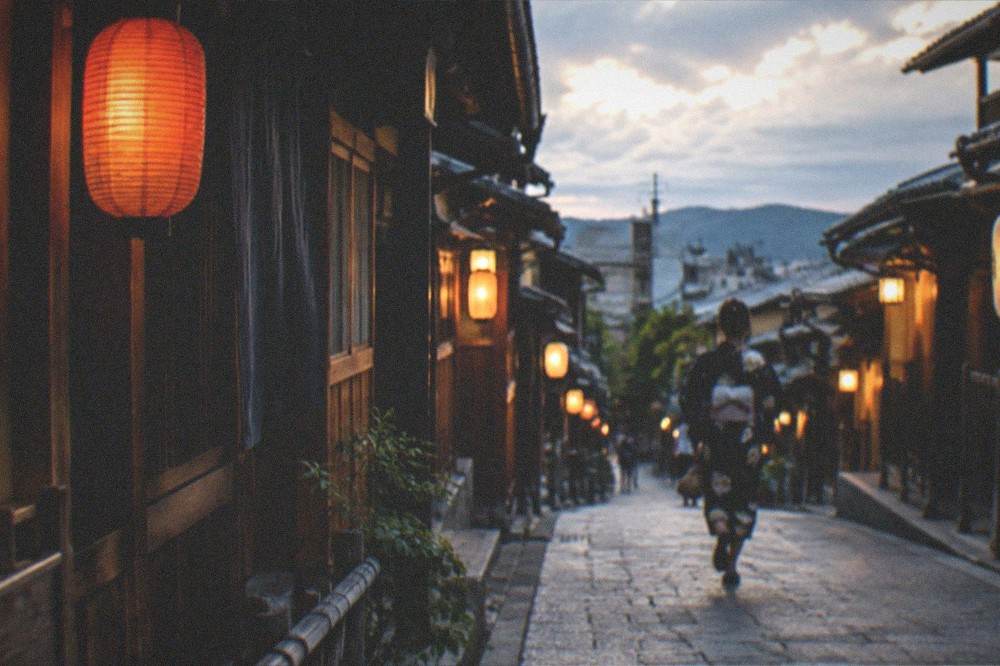
The short version: Kyoto's budget problem is not the price of its sights, because its best sight is free and most of the rest cost less than a coffee back home. The problem is stale information, a 500 yen figure from an older guide that is now 1,000 at Ginkaku-ji, a bus pass that no longer exists, a tax tier that changed in March 2026. Verify the fee on the venue's own page the week you travel, put the one-day pass on an IC card, eat where the market stalls and set-lunch counters are, and the city becomes one of the more affordable places to spend a week in Japan.